The Draftsman’s playlist: music and a novel

I was reading somewhere that authors like to have a particular playlist running in the background while they are working. I cannot imagine anything more annoying or likely to mess up what I am trying to write. But perhaps it depends on the type of music you like and if you like super samey bland stuff, it probably doesn’t interrupt what you are doing. But if you like music that’s in your face and challenging, it’s likely to get you twitching and fidgeting and that’s not good for the typing or the lexical accuracy.

Musicians are for the most part poets too, so words set to music from the likes of Stormzy or Springsteen are going to knock out any other words in one’s head. Like many people for whom music is an intrinsic and constant part of their lives, I do like to see musical references in a novel. There are quite a few in The Draftsman. It wasn’t part of the plan, they just snuck in.

The playlist for the book, in no particular order runs as follows:

         Billie Holiday – Isn’t it a lovely day;

         Andrews Sisters – Don’t Sit Under the Apple Tree

         Glenn Miller;

         Lonnie Donnegan – The Party’s Over;

         Richard Thompson;

         Elton John – Saturday Night’s Alright;

         Gerschwin – Rhapsody in Blue;

         Louis Armstrong – West End Blues;

         Ma Rainey – Black Cat Hoot Owl Blues;

         My Chemical Romance;

         Queen –  Bohemian Rhapsody

         Meatloaf – Bat Out of HellTwo Out of Three Ain’t Bad

         Chopin – Nocturnes

This is the point in the blog where I should explain in very erudite language the reasons for having musical references in a novel. They are as follows (according to me, that is):

         Music in a novel makes it more interesting

         Musical references can be used as a narrative device

         Music is a means of shifting the plot

         Song lyrics can remind people of some shared experience

         It’s random, based on what was playing during the writing

         All of the above

         None of the above

These reasons are all subjective and completely depend on the work you’re writing, the target reader and the selection of references. So it’s all rubbish and none of the above is a hard and fast rule.

But perhaps an explanation of the choices I made for The Draftsman is worth exploring, so here goes. For me there is no musician to compare with Billie Holiday. The breadth of her work and interpretations are still astounding and utterly unmatched. Billie was a warrior and she rarely backed down. A fighter who was alone and under attack, deceived and abused for pretty much her entire life. And yet the work she produced is sublime, beautiful, resonant, tender and joyful. It endures and stays ahead of her and all times. I even heard Billie singing in Tesco’s over Christmas. I was in the bath and shampoo aisle, and she wafted down “I’ve got my love to keep me warm”. Said it all really.

The Andrews Sisters are a different part of the soundtrack to my life. My sister Candy and I used to mime along to the Andrews Sisters, although the details have faded with lack of use. I just know that whenever I hear the Andrews Sisters I can’t help but think of Candy and her gifted mimes, right down to the accents. Glenn Miller is of a piece with the Andrews Sisters in many ways, but mostly I love his work because it takes a catchy tune and breaks all the rules with complicated yet accessible arrangements. Defiant and up and positive. I don’t know if he and Billie ever played together though they had lots of colleagues in common. 

My dad Colin Bowden 29:II:1932 – 01:VIII:2021 Thank you for all that wonderful noise.

Lonnie Donnegan was once, a very long time ago, a part of my life and has echoed over the years for diverse reasons. The song referenced in The Draftsman, played at the protagonist’s father’s funeral, is not one that Donnegan was very famous for. But my dad once told me what it was about and, since it is about the end of an affair, I find it deeply poignant and tender. And I don’t know whether Uncle Tony had lots of affairs (probably) but if he did, the song adds another dimension to the man. It also reminds me that my own affair with a married man might have ended very differently, and not in our very happy marriage.

I could not overlook Richard Thompson in this book, not least because he’s up there with the poets, and also writes clever tunes and snazzy arrangements. Although we are both English, it took an American, my first husband Todd, to get me to listen Mr Thompson’s music. There were lots of girls at school keen on Fairport Convention et al but I became too obsessed with Elton JohnBillie Holiday and Gerschwin to notice much else. 

And Elton John’s was the first non-Jazz gig I ever went to. I was newly arrived back in London following a few silent years at a school in Brooklyn, and Jacqui Smith asked me if I would like to go to see Elton John play at the Fairfield Halls in Croydon. I was 14, intensely lonely and still wallowing in the ugly facts of the previous five years. And I had no idea who Elton John was. I said yes straightaway and loved every moment of the gig. I even got to see Marc Bolan who came on at the end. I only noticed because Jacqui screamed so very loud and dragged me to the stage. I’d never heard of Marc Bolan either, and he just looked like all the others on the stage. Maybe bigger hair. Now the memory brings back the colours and the noise, the stink of sweaty men and an audience who knew the words to all the songs. In Croydon.

If you can do the dots, you’ll love the sound of this in your head.

At that time I was still more interested in jazz but was trying to be more grown up, to pull forwards. I don’t know where I first heard Gerschwin’s Rhapsody in Blue but I fell in love with it and still it’s one of my favourite things to listen to. It brought me closer to Alison Taylor at school. Alison was a classical violin and piano player extraordinaire, bent on defying her parents ambitions for her by embracing jazz. Gerschwin was as close as it got. Gerschwin and then my dad because her boyfriend Billy liked him. Billy was aware of my dad before he was aware of me which Alison thought dusted my dad with glitter. I rather liked that. Nowadays I rarely listen to Gerschwin because Alison always jumps up to sing along with me. Ba ba ba baa ba baba baaa baaa. She died some years ago, but I still can hear her. All of us who knew and loved her can still hear her.

No one with an interest in jazz can overlook Louis Armstrong, a man whose presence in my life has recently become much more vivid. You won’t hear a more inventive bit of horn playing anywhere than Armstrong’s introduction to West End Blues. Our friend Winfried in Berlin, one of my dad’s oldest and most loyal fans has a Louis archive from 1963. He’s bequeathed it to the Louis Armstrong museum in Queens and it’s fantastic to browse. Winfried calls him St Louis Armstark.

I don’t know what made me reference Ma Rainey and Black Cat Hoot Owl Blues but I think it was probably the fact that her real name is Gertrude Pridgett and I have always loved that. She also sings in a moany sort of way that has echoes in the vocals of Bessie Smith and of course the sainted Billie.

When it comes to My Chemical Romance this is not a band I have ever much listened to. I think the reference weaselled its way into The Draftsman because my daughter Hannah was a big fan. I remember collecting her and a friend, Christian, I think he was called, from a gig in Brighton. They had explained to me that I wouldn’t need to park, always a struggle in Brighton, and that I would be able to find them because they dressed so distinctly. “We’ll stand out, so you’ll find us”. I think they were about 15. I got to the venue and tried to spot them, superbly camouflaged amongst hundreds of other teenagers in black jeans, white shirts, all black eyed and scowling. Hannah’s white blonde hair was fortunately unique amongst the throng.

Don’t you just love Meatloaf? He’s so loud and tender, in your face with his gentleness and the whole of the Bat Out of Hell album is unrelenting brilliance. It’s Meatloaf’s first album and I have never understood how work that is so melodic and poetic could be called Heavy Metal. Its honesty and poesy are probably why it’s one of the best-selling albums of all time. 

And what book would be complete without a reference to Queen? I had a very wealthy boyfriend who was ten years older than me when Bohemian Rhapsody came out. Another nine minutes plus long song. He gave me the album for Christmas and I wasn’t particularly thrilled (Elton still ruling). But I still have the album and as Elton faded into blah blah, Queen just kept on getting better and better and I was hooked. No so on the boyfriend, despite the Rolls Royce and the Jensen Healy. They couldn’t begin to make up for a total absence of personality.

Towards the end of the novel when The Draftsman is hiding up in the woods from friends and family, he hears music drifting up to his secret place. I don’t know why it had to be a Chopin Nocturne: they were all down there at a barbeque and you really would have thought something a little more upbeat would have been playing. Except as the draftsman’s torn and twisted psyche was fighting to right itself, Chopin would have been high on his agenda as he put together the party’s playlist. 

Martin Cox’s musical interests are actually a lot denser than I realised in writing the book. Just another part of the man that I only started to understand as the book went on. He’s stayed hidden for most of his life, so I suppose I should be glad that he clambered into my head to share himself on the page, even if only a little bit.

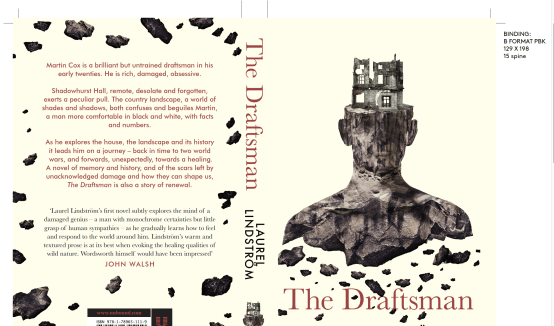
The Draftsman Launch Imminent (April 2021)

Unlike the actual book production process, reaching the point where a manuscript is finalised has been long and slow. And it’s left plenty of time to ponder that despite advances in digital prepress, the book publishing process is about as efficient as it was in the days of hot metal typesetting. Book people still actually refer to typesetting, even though everyone else calls it page layout and composition. And the idea of variable data novels, where you can have multiple different endings for instance, don’t even think about it. The slow production processes which were up-ended in the 1980s, were of a piece with slow book editing and design processes. But where prepress is now rocket-fast, editorial and design processes for books still seem to take an absolute age. It’s at once frustrating and sobering.

Hot metal type.
Permission is granted to copy, distribute and/or modify this document under the terms of the GNU Free Documentation License, Version 1.2 or any later version published by the Free Software Foundation; with no Invariant Sections, no Front-Cover Texts, and no Back-Cover Texts. A copy of the license is included in the section entitled GNU Free Documentation License.

From a writer’s perspective, it’s as well editing takes so long and has to be so drawn out. Reading a novel, even a little one, takes so much time. It requires care and attention to detail, so fixing a dodgy piece of work necessarily takes an age. Editors need plenty of time to recover in between sessions. Whatever the quality or not of a manuscript, editors must also have a vision of what a book is trying to become. And writers must be super-disciplined to avoid the temptation to completely overhaul the thing, rather than make judicious edits as the editor requests. This is especially difficult for writers with a sparrow’s attention span and a memory that dumps every word once it’s saved and filed away somewhere on the desktop. Maybe it’s on a memory stick (which one?), or the laptop or iPad? Or maybe it’s only alive on that extra hard-drive. Wherever it lives, it’s by no means in one’s head any more.

The novel production process only really begins with the editing process. The carefully organised and curated words are just raw material for an editor to advise on what the book is really about, who the characters are and what happens when. The editor sees the manuscript as an independent entity, unhitched from the writer. At each stage in production the thing comes into sharper focus, moves further away from its creator and into the light of its own being. The structural edit, then the copy edit, the proof edits, each add definition for what the finished work will look like. Like bringing a photo into focus or balancing the sound during a live music performance. By the time the author reads the final PDF or three, they are seeing a sharp picture, hearing all of the music. Then when the writer is ready to sign off on the manuscript they often need to have a little lie down, or at least another cup of tea and bar of chocolate.

Where I am now with the Draftsman is the post-signoff-lie-down-with-a-cup-of-tea-eat-more-chocolate stage. I have also approved the cover, so the next thing is to wait. The good news is that as this production saga has been so protracted Unbound has agreed to make advance copies available to all supporters, prior to the launch date of the 29th April. I don’t know when the advance copies will be available, so every delivery van hurtling past the study window makes me jump up, just in case. It’s surprisingly good exercise.

Between now and the launch date we will be working to get some visibility for the book, ideally through online book reviewers. I am working with Barnett’s of Wadhurst, our local bookshop, for an and will hold a launch event at the National Liberal Club in London. Except I have no idea who to invite. I intend to write some reviews of The Draftsman myself, all of which will be about all the things I hate about the book.

Then there is the identity anxiety, a corrosive confusion that won’t go away. Few authors dare not call themself ‘author’ in the beginning. It sounds even more pretentious than saying ‘I’m a writer’ when someone asks you what you do for a living. I’ve been saying ‘writer’ for the last 35 years, because it’s basically been how I have supported myself. I am comfortable with this and inclined to hide behind it. And I’ve had a handful of book-length titles published, am a member of the Society of Authors and the Authors’ Club. Yet to describe myself as an ‘author’ feels just way too bold and far beyond me. Until now; -ish. Now that The Draftsman is done and the publisher is sending the pages to Clays (digital and analogue printers extraordinaire) to be printed, it seems okay to use the word ‘author’. I can nearly, almost, say it without feeling that I somehow grubby other, real, proven and proper authors.

If once we are allowed out, someone says to me, ‘so Laurel Lindström, what do you do for a living?’ I hope I’ll be bold enough to smile and breezily say, ‘I’m an author’. And then I’ll wonder if they spot the paradox in this reply.

Delete #2 New Boy

(The first in this series was published here: https://writetime.org/anthology/)

The whisper went around the classroom, every time Miss turned to the board. Fight. They’re going to get him. After school. That’s what John Carter said. Little new boy‘s gonna get it. But Mrs Vurley didn’t hear it as she turned back to her year 9s and reminded them of the homework. Pointing to the board and “… by Friday no later please.” The bell rang and Mrs Vurley watched them pile out from behind their desks, rushing towards the door. She hadn’t heard the dark whispers but she watched as the new boy slunk away from her, separate from the rest. Did she see fear? “David, David? How are you settling in?” “Yes Mrs Vurley,” he mumbled. Mrs Vurly put her pencil behind her ear and looked at the boy again, eyebrows raised. She sighed. “Hurry now, it’s hometime, you’re out of here for today.” Looking up at her he said, “Yes miss, but John Carter said …” “John Carter? What about John Carter?” Mrs Vurley didn’t have a John Carter in her class. “John Carter? I don’t think I know him. What about John Carter?” “Nothing miss” said David moving quickly to the door. Delete.

Mrs Vurley looked out of her window at the usual scene of children milling towards the school gates, the lines of cars waiting for some, parents waiting for others. A few were on foot heading home or for the bus. There was only one small knot of boys, with a couple of girls in tow, lingering by the gate. She didn’t see David out by the gates and gradually the group of boys and their groupies drifted away. 

When David came to school the next day as soon as his dad dropped him off he ran a gauntlet of teases and taunts. His dad smiled as he watched with fond memories of his own school days. He didn’t see what he was seeing as he drove away, lost in reveries of a super posh school for boys. Delete. He didn’t hear when they said “white boy, hey whitey, come on, come on tell us who’s in that picture. We got the picture innit. Who is she?” As he drove away his brain had the scene with his boy centre stage, but he wasn’t seeing it. Delete. His brain heard the voices, unhearing the words. Delete. He moved on and stopped thinking about his boy. Delete. 

The catcalling was lost in the group, and no one was brave enough to be seen specifically to call out to the new boy. “Fresh off the boat are ya? Fresh from Alabammer are ya? Black Lives Matter ya know, yeah.” Fist saluting and laughing and then mocking his accent, like he was from the deep south and not from New York City. That accent was harder to copy his dad said David had told him when it first happened. And his dad, strong and tall and believing himself a streetwise New Yorker had no idea of how alone his child was. Delete. And so David didn’t speak much at school, not after the first day when he said his name in class and they were all supposed to welcome the new boy. Instead they stared at him and laughed at the way he spoke. Afterwards a couple of them had asked him his mobile number, although he didn’t know what they meant at first. “Oh, cell you mean my cell?” And that had set them off. “Yeah, your cell Yank. Give us your cell.” And they’d all laughed. David small and living in his head, processing the new country, this city school, the scale of it, the weird sports and having to read so much, write so much, confused and uncertain and very alone.

In the staff room Mrs Vurley was reminding herself of what they were supposed to look out for so that they could submit a pupil concern email. In her day bullying was just part of the day, some children were just marked out for it. Would it be how fat or thin they were, how shabby their uniform or beaten up their shoes? Would it be how clever they were or how stupid? Would it be their accent or how clean or dirty their hair was? Would it be how small or big they were, geeky, Jew, Christian or Muslim? She knew that it was impossible to predict, but that it hung on a chance moment, a thin thread and an unpredictable hook. And it was part of school life, ugly or not. Now they had guidelines and rules which at least gave an opportunity to do something. Now at the first sign they were alert and could take steps. And guidelines meant there was no need to convince sceptical staff or heads. Guidelines meant they could do something, not nothing. But guidelines and actions could also push it out of view. Delete.

It was Mrs Vurley’s day to monitor the lunch room so she made a point of watching this new boy, freshly arrived from America with his heavy accent and fretful eyes. She saw him sitting alone as two bigger boys took their places on either side of him. But she didn’t see David leaning forwards into his tray nor did she see the two boys sit closer and closer. Both had been held back from last year. Neither was bright and both were strong and confident, popular. They had pulled their chairs in close to David and were leaning into the boy. She smiled as she saw the Kendulu boy suddenly pull away and David fall sideways under the force and weight of the kid on the other side and they were laughing. Relieved Mrs Vurley turned away to deal with a fuss about mashed potato blowing up in the queue. Delete.

But her attention was soon drawn back to the boys. David’s tray had fallen sideways with him and Kendulu was no longer laughing, but up on his feet. “Look what you done man, look what you done, your shepherd’s pie is all over me trousers. Look at the mess you made!” And his friend jumped up to join in. “Look what you done to Ken’s gear man, look what you done.” They were both towering over David, hands pointing upwards, heads turning from side to side, voices rising, looking for the audience, for response. And they were laughing and patting David on the back. It was impossible to see that the pat was just that little bit too hard, lingering just a little bit too long pushing the boy down. David tried to stand but they had blocked his chair with their feet so he was stuck between the table and his chair half up half sideways and now Ken’s leg with its smears of shepherd’s pie is in David’s hair. It was time to intervene and as Mrs Vurley hoved into view both boys stood back, moving their feet and smug as David’s chair scraped unexpectedly back and he fell onto one knee, baked beans stuck to the tears and his tormentors with their hands in mock surrender. “He’s such a laugh Miss, he spilled his food on me on purpose miss. I done nothin’” and “Yeah Miss, it was on purpose, he’s bullying us, he thinks he’s cool ’cos he’s an American miss.” 

As two other staff members started ushering the small audience back to their food, Mrs Vurley looked at the two boys. “What’s this about?” “David?” “Ken?” “Jason?” David said nothing, but shrank even smaller into himself. Kendulu repeated it was on purpose and that they were being picked on by this new boy, who thought he was so great because he came from America. “And you Jason, what do you have to say?” “It weren’t me miss.” The bell rang and Mrs Vurley gestured them away and the two boys sloped off leaving David alone. As he looked up to answer Mrs Vurley’s unheard question David saw Jason draw a long finger in a straight line across his throat, before turning it into a wave and a laugh as Mrs Vurley followed David’s gaze.

“David, how long have you been at this school?” Mrs Vurley was a little embarrassed that she hadn’t really noticed the boy. Delete. Embarrassed but unsurprised. He was an unprepossessing thing, quiet and withdrawn, keeping his head down, avoiding contact. “Five weeks Mrs Vurley.” “Five weeks” she repeated, ”and how long have you been friends with Kenulu and Jason?” David stared sullenly at his lunch tray and its unappealing mess. “They’re not my friends” he mumbled and tried to straighten his shoulders, tried to claw back some sense of dignity. “But they like to follow me and send me messages on FaceBook an’ all. So maybe. Dunno.” There followed a series of questions, questions that Mrs Vurley knew she should ask, even though in the back of her mind she knew the answers already.

Yes, there was harassment, although he was evasive as to its frequency and intensity. Yes there were incidents, like today only mostly unseen and yes there had been unflattering pictures posted online and shared with various school groups. Girls and some boys sent him flirty messages and then ridiculed his replies. They invited him to online chat sessions only to block him at the last minute or worse to hide behind fake accounts and make ugly threats, sometimes with pictures of cats with their throats cut, or birds with their wings ripped off but still alive and bleeding. They threatened to tell his dad that David was staying over with friends, but really they planned to kidnap him and sell him as a sextoy to white supremacists. Mrs Vurley rolled her eyes at this, but still. The digital world’s a dangerous place. “How many David? How many boys and girls are doing this to you?”

By this time David was crying and the lunch room was empty. Mrs Vulney was glad she had no lessons this afternoon and persisted. “Do you know what mobbing is David?” “No miss,” he sniffed. “Do you know how to block people on your social media accounts?” “My dad’s told me I should do that and I’ve tried. But Snapchat messages disappear straight away and they use fake names. I know it’s them, and I want to be their friend though. That’s why I kept my Facebook account after … ” “After what? After what David?” “Nothing” he mumbled drowning in their power. Delete.

As she hit send on her email and its attached Pupil of Concern form, Mrs Vurley hoped that her colleague’s initial call to the family would go somewhere. It didn’t. They laughed it off. Delete. But later Mrs Clayman tried to talk to her son, except that the talk was more a forced encounter. A bully’s privilege? “It’s gone.” “What do you mean gone, David? Are you being picked on or not. You have to tell me.” “It’s gone because it’s SnapChat. The messages disappear straightaway.” “Don’t lie to me David. That makes no sense. I know you’re hiding something from me.” Mrs Clayman didn’t know she needed to get him to take screen shots. Would he have done? Would she have looked? Delete. Mrs Clayman tried another line. “Well what about FaceBook? Show me what you’ve got on FaceBook.” Here David had more to say, “I know I should block them on FaceBook, but if I tell them I’ll block them they just laugh, ooh you know how to block do you. Then they send me notes in History saying sorry. So I unblock them, then it’s ok for a while and then it starts up again. And on Instagram they pretend to like my pictures, but they’re just mocking me. You can tell in the comments.” The tears were rolling down his cheeks as David continued: “And I tried setting WhatsApp so that no one can see my picture and status and Aunty Jean got upset, so I put it back.” David could see that she wasn’t hearing what he said, wasn’t seeing, was inhabiting her own old world. Delete.

Mrs Clayman was starting a block of her own. This was all too silly. They’re just boys being boys with the new kid. It will pass. He was still adjusting to the new life. The school had it in hand. “David, let’s keep this in perspective shall we? They’re just lads and you’re different and sensitive, you know that don’t you? Let’s not get all bent out of shape about kids at school. It’s just their way, the British way, you know that I am pretty sure. You’ll get used to it. It’ll be fine.” Delete.

Sex in The Draftsman

There isn’t much to be honest, at least not much that is actually described, breathless and torrid. Sorry if that’s your gig. Sex is however one of the underlying themes of the book, even though the sex scenes aren’t explicit. In part this is because trying to write a sex scene is just so cringey. Try it and you’ll see what I mean. I have found that whenever I try it, the words invariably twist around and turn themselves into something that is very funny. I didn’t want that to happen in The Draftsman, so I avoided getting into too many details.

Is every exploration basically about sex? How do we need to understand it? What is its contribution to identity? Not sure. Read the book and tell me what you think. Or not.

The other thing that happens when trying to write sex scenes is that I start to blush and get embarrassed even though I am alone. It’s a problem and I don’t know any other writers well enough to discuss this with. I do know that when discussions head into the sex weeds in creative writing classes, the women take the topic very seriously and the men stare at their shoes. Perhaps it was just that particular group. Or perhaps sex is something that men writers find harder to chat about than women writers do. I fall into the men writer category, and I do have some very lovely shoes.

In The Draftsman, protagonist Martin Cox is a man whose sexuality is not clearly defined, it’s ambivalent. He’s a man who is always alone and who functions mostly in his head. For him sex belongs in an abstracted part of his psyche, a need rather than a dimension of his identity. Martin’s interested in sex, but not in any of the dramaturgy that for most people has to go with it. He just doesn’t care, cannot relate to any other aspect of his sexual partners, and is only concerned with their willingness to oblige. For Martin sex sits in its own box. Like hunger or the need to sleep, it’s not a defining characteristic of Martin Cox and it isn’t part of his identity. And yet that may not be entirely true.

Obviously I know why that is and you will too once you’ve read the book, but I wonder how widespread this disconnect is. Do we wall up parts of our natures in spaces that only occasionally can be accessed or, more darkly, that surface unexpectedly? This is an idea I plan to explore in the second book about Martin Cox, as he learns more about what happened to Ruth Lorne and her Canadian lover. In The Draftsman we learn a little bit about these characters, but only superficial details gleaned from diaries, police reports and newspaper cuttings. Ruth and Charles are certainly lovers, but sex may not have been part of their shared experience. Martin can be fascinated by these two people precisely because they are from another time, distinct from him but linked to him through their shared localities. They spent time in the same landscape as Martin, but over fifty years ago, far away enough on the continuum that Martin doesn’t need to integrate them into his world. They are in their own private box.

Martin Cox may be afraid or anxious about relationships and making a connection with someone who might have expectations about where that connection might lead. But this need for separation doesn’t have to be fundamental. This is addressed briefly in The Draftsman, but its implications are likely to be missed by many readers. That’s my fault for failing to add sufficient data to the scene, but the lack of data is precisely why Martin Cox reacts as he does to traumatic situations, including sexual ones. Read the book and let me know what you think.

Oscar Wilde in the 21st Century. What would he say?

What would you say?

The Oscar Wilde Society recently held a competition for members to come up with aphorisms and epithets that a 21st century Oscar Wilde might have said. One of my submissions made the short list of 20 out of 300 submissions. 

Since then I have come up with a few more. But can you guess which one made it to the list? Answers on a bee’s wing please. Enjoy!

Restraint of speech and imagination enslave ideas to the bondage of the masses.

Being told what to think, is the greatest luxury of 21st century life.

To explain my absence I tell my friends I am having issues.

The art of the influencer is not the same as the influence of art.

That subjects and topics could have ownership is fundamentally undemocratic.

Restrain imagination and all progress will cease.

Self-obsession, the 21st century’s favourite disease.

Health and fitness are vastly overrated.

Beauty and deception are natural partners.

In the digital age, opportunity and responsibility have become irreconcilable.

Morbidities are ambitions for the unrestrained appetite.

A convenient alternative to an alert intelligence is to be woke.

To label one’s sexuality is to confine it.

An agile mind may lurk behind a lardy physique.

Sex and labels are both so exciting, but not necessarily in the expected ways.

Diet at your peril.

Social media is neither social nor mediating.

Trump and Johnson are delightful entertainers. They take satire to a whole new level. 

Being fat is one of life’s great joys and its greatest sorrow.

Climate change is the planet’s way of telling us we’ve gone too far.

Having issues is a mysterious way to admit that there’s a problem. And problems are so much easier to address than issues.

What does should of mean? I should’ve asked before.

The Draftsman and technology in the age of XXX

The world is awash with writers, fitness trainers, dog walkers, chefs and book bloggers. And around each of them is a web of service providers, sales channels and even sometimes paying customers. Yet very few of us have been able to give up the day job. As a début author (The Draftsman) I am totally drowned in an ocean of other writers and overwhelmed by the expectations of what one must do to stand out and build a following in the wild, wild world of XXX where XXX means whatever you want. It doesn’t seem to have much to do with the work, the actual book, but everything to do with how skilled you are at managing the online channels, from Amazon to Wattpad (don’t ask), and how good you are at name dropping. And I am absolutely crap at all of it. I don’t want a relationship with algorithms or the XXX anons.

This is ironic, given that I have spent my career writing about technology, and that technology is what’s making all this possible. From word processors like Apple’s MacWrite and Microsoft Word, through to layout tools and the container for print ready pages that is PDF, I’ve been mostly on top of it. Looking back over the years I am pleased to see so many of the amazing innovations we’ve covered, now in the hands of so many creative people. These media production technologies are cheap, readily available and make it possible for anyone to produce a book, newsletter or whatever. And that has driven author incomes down.

The Draftsman, one in a gazillion.

It’s been the same story in the music industry as technology made production processes cheaper and accessible to more people. This is all quite wonderful because it lowers the bar to entry, so that more ideas can be shared in many different creative ways. Technology is central to The Draftsman, and how clever inventions make a difference to inventors, users and the planet. 

Technology is central to everything, so it’s fair to say that the publishing industry’s raw material, imagination and passion, is completely entangled with it. Today writers must develop an online following in order to be noticed. The online following comforts publishers who might be reluctant to take risks with new ideas and points of view. A following suggests a swathe of keen buyers and so informs budgets, project planning and print run lengths. Technology creates opportunity for so many expressive formats and allows publishers to identify and target potential readers for a given work. But there is way too much noise in the online world and much of it is self-serving and rather ugly.

In The Draftsman, set in 2006, two years after FaceBook launched, there is no social media apart from a passing reference to emails and the speed of internet connections. And there is a bit of foresight too, when Martin Cox ponders the rate at which many forms of printed content will migrate online, to decimate the printing industry and create opportunities for new business models. Even in 2006 when FaceBook was only two years old, it was clear that internet technologies were reaching not just into industrial applications, but also becoming central to daily living. By 2012 when FaceBook went public the platform had 845 million users and social media was a habit.

And yet I didn’t want Martin Cox to be an online junkie. He’s obsessive and dark, and what he would do with an online existence would be as obsessive, as dark. I didn’t want to write about how dark, given his personality and history, and his various confusions. But perhaps I should have done because that would have required more research into the whole social media eco-system and the paths through it. It might have made me a more adept manipulator of the channels and algorithms and it might have made me more popular, in a bitsy sort of way. (That’s binary digitsy, not little particles.) And the darkness in The Draftsman might have found an audience. Then I would have lots of followers and publishers might have been swooning at my feet. But then again, the lack of swooners might just be that I don’t write as well as I think I do. Read The Draftsman and decide for yourself. Ever yours, XXX.

Oscar: A Life by Matthew Sturgis (not a review in the end) – if you want to know more about Oscar Wilde go here:

https://oscarwildesociety.co.uk

Dear Oscar,

My hero.

I am writing to tell you about the latest big fat biography of yourself, you, Oscar Wilde. You’ve probably already read Oscar: a Life by Matthew Sturgis, but if not do. It’s a vast catalogue of your life, a huge collection of facts all gathered together in a single volume and narrated with lively enthusiasm by historian Matthew Sturgis. Even for people not inclined to read or to learn more about your sainted self, it’s an easy page turner. Like you, the book is an astonishing achievement, exhaustive, charming and compelling, and only minorly flawed by the publisher’s sloppy production.

The book tracks the timeline of your life with immense detail. Your upbringing in Ireland and time at Portora School are carefully documented, along with masses of skinny on your relatives, family, friends and contemporaries. Your brilliance and sometime (fleeting) sportiness are shared, as are the details of your move to Trinity College Dublin and thence to Oxford. It was at Oxford that your identity as an artist started taking tangible shape, along with your previously under-developed abilities to command attention, involvement and direction. You’re soon drawn to London and its fashionable society, a larger and more demanding stage where you continued to thrive rising slowly through the soup. But you had no readily accessible means of earning a decent living, despite winning the Newdigate Prize for Ravenna in 1878 and publishing Poems in 1881. Transition was needed from poet, to performer, author and playwright, and was soon in motion.

The brilliant idea of an American tour was almost a disaster following your first performance in New York City in 1882. D’Oyly Carte had wisely hedged his gamble with only a single booking for the preening society aesthete with unproven oratory skills. Subsequent tentative dates were only to be confirmed following responses to the initial outing. Despite a rough start, the lecture and the jokes worked out and you grew over the coming months into a polished and popular performer.

It was clear from the outset that Oscar Wilde’s outwardly shifting persona would respond to the demands of audience as it did throughout the 1882 US tour. But persona and audience morphed in tandem throughout your life. Aspiration and vanity, victories and collapses, your evolving sexuality from heterosexual, bisexual to homosexual, shaped your identity and presentation. A pattern in others’ of cautious or bold risk-taking, mirrored your own mercurialism. It traces across your life: diminished risk to publish or stage your work as your reputation grew; increased risk to commercial ventures of your notoriety and attendant outrageousness. No rules. 

Mr Sturgis presents a clear picture of your obvious brilliance and magic, and also of your vulnerability to flattery and beauty. No surprises there. And throughout his work Mr Sturgis energetically corrects errors in literary critic Richard Ellman’s definitive biography, published after Ellman’s death in 1987. But the huge numbers of typographic errors publisher Head of Zeus has allowed in Oscar: a Life rather undermines one’s confidence in these corrections. I am sure someone has already pointed them out, but throughout the text’s 720 pages there is barely a chapter without mistakes: your funeral was on the 3rd December, not the 3rd November. Is it Salomé or Salome? And shouldn’t pronouns and verbs agree? 

We learn that intellect untamed searches always for innovative ideas, insights and perspectives no matter how grungy their habitats or philosophy (remember the Decadents?). Pushing the ideas of others to their limits, challenging social convention and expectations whether in poems or fashion or home décor began with you, you, Oscar Wilde. And it’s what all of us now aspire to. Aesthetic traditions, their particularities, expression, are conversely universal and unique, for individuals are simultaneously ordinary and exceptional. Whatever the green eyed James Whistler charges, your aesthetic persona and expression are more than a reworking of someone else’s philosophy. Thankfully this comes through in Oscar a Life.

It’s also clear that your genius morphs with your humanity, kindness and individualism subverted, or glittered, with vanity and ego. The emergence of the Oscar Wilde persona began early, grew as your genius became apparent, was amplified by fame and then started to distort. But never, ever did your brilliance, underlying decency and generosity of spirit diminish. Throughout the public scenes, trials and imprisonment, consideration for others was always there. It too often got lost in the torrent of passion for Bosie and his evil influence and subculture corruption. Denial and shame made you spiteful sometimes, as guilt and embarrassment periodically trumped kindness. This was particularly and horribly evident in your dealings Constance and others whom you should have trusted more. But you know this.

Knowledge, carnal or otherwise, was always your fuel but sadly wisdom too often lingered a little too long, as it does for most of us. Our shared frailty is why people still read and enjoy your work, why love for Oscar Wilde is spread so far and wide. You are not forgotten and your influence persists, variously cloaked in notoriety and hero worship. It’s acknowledged by those who know you. It’s obviously unacknowledged by those who are unknowingly beholden to you, but they are many.

You show us the origins of much that distresses modern life: performance and identity, the need for audience and attention, the desire to be heard and taken seriously, understanding what it is to be as one and as one of many. The paradoxes in which you so delight are clear in both biographies. Truth and lies, male and female, brutality and gentleness, hypocrisy and faith, the secptic and the trusting, mirrors all. But the paradoxes are clearest in your works. They veil our ugliest traits, our vanities and deceits, ignorance and denials. In the darkly radical The Picture of Dorian Grey and the evanescent humour of The Importance of Being Earnest our own hypocrisies are played out.

You were not self-destructive (too vain for that), but rather caught in a vortex of events, shocked and horrified at your own reversal, that your gainsayers really did mean it. That this time there was no chance of rebounding. You knew disaster was coming but instead stood fast, brave, and faced it. It was a matter of honour and truth, of the artistry of life in black and white and of your own integrity in the dock. You stood on a stage of your own construction and were not cowed when enemies tried to dismantle it. Not then, not now.

Ever yours,

– A Woman of Even Less Importance.

PS “…No longer now shall Slander’s venomed spite 
Crawl like a snake across his perfect name, 
Or mar the lordly scutcheon of his fame. …”

Delete

(published November 2021, in WriteTime Anthology Two http://www.writetime.org)

Meredith March studies the wreck peering at her from the mirror and adds a touch more mascara to already overly mascara-ed eyes. She is always heavily made up, having never fully recovered from her Dusty Springfield circa ’69 phase.

     She’s sitting at a mock rococo dressing table wrestling with curling tongs. The dressing table has three mirrors so there’s no escape. The curling tong cable has folded back on itself in many places and refuses to straighten. Not in its nature. When Meredith tries to grab a lock of hair with the tongs, the tightly wound cable kinks, stiff and unyielding, knocking over bottles and assorted lipsticks. Stuff rolls to the edge of the dressing table. Meredith tries to stop things falling to the floor, but the tongs burn her cheek and tear her hair. Weak tears streak black under her eyes. Three sad faces remind her that she is tired and forgotten and life’s pretense is overwhelming.

     The dressing table vibrates. There’s a message on her phone. “On way,“ it says. “Flight on time.”

Very happy to have been included in this collection. And flattered.

     Delete, she says. Delete and back to the primping which needs more care to be convincing. Delete says Meredith aloud at her three reflections, carefully unwinding her hair from the too-hot tongs. Delete she says again, dabbing cold cream on the red burn mark.

     Delete. But then what?

     What would she do instead, how would she persuade herself to do anything, go anywhere, see anyone if not for the stranger buckling up and peering out of the window at an airport monotony. He’s her main topic of conversation, with her friends, with the children … but with them less often, they know how she feels about their dad. They understand.

     She knows it isn’t love with him, never was really. They don’t know that. It’s not lust any more, and they couldn’t even go there. It faded in about year three. “When I was seven,“ she ponders, struggling into a loud floral print dress he bought her for Christmas.

     Seven in dog years is 49. Too old to still be living in different countries. Too old to be waiting for him to get a London posting. Too long to be so old, so static, so floral, so tired. Too long for this same routine.

     It wasn’t so bad when the children were young. It wasn’t so bad when the money was anovelty,  and the holidays too. New cars. Shopping with the girls. Inane gossip. Housey housey fixy upping. Following the lines. All of it too old. And now: Delete.

     Downstairs, Meredith checks her black outfit in the hall mirror, florals now under the wheels of a dark revision. She searches for her car keys, checks the time, puts down food for the cat who’s asleep on a sunny window ledge. He ignores her wistful stroke of his head.

     Meredith takes frozen pastries out of the freezer. He likes those Danish cinnamon whirls.

     She puts on her coat, picks up her bag and … Delete. Puts the bag down again and runs upstairs. Breathless, she finds her passport and retrieves her stash of €784 in old holiday money. Waters a plant. Glances around the kitchen.

     The journey to the airport is about as long as the flight from Madrid, give or take. There’s no need to hurry. She ponders his appearance in arrivals. He’ll be underdressed for the murky Manchester skies. He’ll shiver as they leave the terminal. He’ll say: “Ooh, so much colder than Madrid. I’ll need to pick up a coat.” He’s coming back to his home town, but he likes to remind her of his difference, it will give them something to do, something to fill the space between them. Meredith hears the reruns of those filler conversations as she starts the car and switches off the radio. Delete. No distractions now.

     The phone tracker app shows flight BA0461 casting its line across the sky. The M6 is slow as ever and Meredith March has time between stops to scan her phone, check flights, book parking in the short-term carpark. £20 should be enough. Sitting in the traffic, silent, another message on the phone. She texts back: “Yes, I know I booked parking.“ Delete.

     It’s Friday night. They can go and get him a coat tomorrow, hit the shopping mall masked and hand-sanitised and count the empty stores. He’ll want a pub lunch. She’ll explain that they can’t. He’ll tell her this commute will only be for another few months. And then he’ll change the subject.

     She turns on the radio: “A shooting in Tampa, Florida … ” Delete. Tampa, Florida. We were there once. Flew in direct and spent two weeks arguing about alligators and sun cream with the children. Tampa. Delete.

Pulling into the short-term car park, watching the barrier bounce satisfyingly up, Meredith March smiles, parks and switches off the engine. She leaves the key on the rear passenger side tyre and turns away. She is early. There is time to kill. Kill or be killed. Delete.

     When Mr March in his too-thin coat comes out of arrivals, his expensive four-wheeled carry-on in tow, Meredith is watching out of sight. She notes his handsome profile and the way his look slides across the people waiting, as he seeks her out. She’s not quite ready to turn away.

     She sees him frown, sees him tap at his phone and wonders why her phone isn’t ringing. As Mr March stands legs astride his case, Meredith March heads quickly for Security before anything can happen to divert her. Amidst hoards of people she is reminded to social distance and to keep moving.

     The bored security man in a purple turban is repeating his lines as he scans the queues, checking, always checking. “Laptops, tablets, shoes off, coats off, number four please, and madam to number two. Take off your jacket please”.

     Bang bang with the boxes, through the screener, then shoes on, coat on, tablet retrieved. Phone buzzing.

     A host of duty free shops on the other side, a host of strangers, a host of new worlds. It’s credit-card heaven in the Kurt Geiger shop with an excessively-made-up young woman, also channelling her inner Dusty. “Lovely make-up,” Meredith can’t help but say and the lovely young girl beams and pats her beehive. She hands over three bags with three new pairs of shoes and one with Meredith’s discards. “I’ll keep these on and you can keep the old ones,” smiles Meredith, handing back the bag.

     Next stop is an expensive Tumi expandable carry-on for the shoes and now the Hugo Boss Japanese stretch crepe jacket and matching trousers. The Hermés scarf. The Cartier watch. And the lingerie. And the many hundreds of pounds worth of Sisley make-up.

     Another glamourous young woman is massaging her face and holding sample skin tones, head on one side quizzical, eyebrows tight, unfeasibly long fingernails flickering under artificial light. “You have wonderful skin, you know. Shall we try something a little different?”

     “Yes, please,” says Meredith. There’s a message from him. “In arrivals.” Delete.

     She hands over the credit card and glimpses something a lot different in the mirror. She packs the new beauty regime in the new carry-on and heads for the cashpoint, teetering on her new heels. She withdraws maximum cash from all of his credit cards and has to sit down to stop from feeling dizzy. Picks up her phone again. “Waiting.“ Delete. “Are you held up?”Delete.

     Meredith March steps away and checks her gate number, 46. Meredith March heads for the lounge. Sipping cava and picking at cheese she goes online and posts a picture on Facebook of her new suitcase and stilettoed feet with the message: “At airport still waiting for John.“ She crafts a text message to their son: “When you get this, tell him the keys are on the tyre. Level 2 K32. ”

     The phone is buzzing again but it’s time for gate 46. Deep breath. Stand tall in those high heels. Tits and teeth. But that buzz. “Where are you?” Delete. As she wheels along in the high new shoes, behind her mask Meredith is gone. Delete.

Life As A Shortie (something to infuriate the wokers)

As a very small person (VSP) I have lived my life looking up to my peers, willingly or not. Throughout childhood I expected that would end when I grew up, but I hit 4’11” and there I stayed. A life of shortness was all that I could look forward, or up, to and so far it hasn’t been all that great. Handrails are always too high, stair steps too tall. Mayonnaise jars are just that little too fat to hold safely and I have to jump to reach the car boot to shut it.

Even on tiptoe and in high heels, I am still too short to see what I am doing.

Understandably the giants in primary and high schools, and the grown-ups everywhere else tend not to notice short people. Why would they? We’re below normal human sightlines, our voices are just a bit too squeaky and far down to be heard. And we’re just so easy to trip over and step on. Elbow bumps have a whole other meaning for VSPs. Standing sociably in a group, stray elbows can send your cup of tea or glass of wine flying, or intrude unexpectedly into your plate of food. Breadroll mayhem. Let’s face it, small people are in constant battle with a world designed by and for nonVSPs.

We face prejudice in so many ways. Grown-up clothes and shoes are invariably too big, even in their smallest iterations. That shop assistant sneer when they tell you, “we’ve nothing that small”. We face perpetual, organised and deliberate discrimination, with constant daily reminders of our shortness. Mirrors in public loos and restaurants are invariably too high. VSPs must jump to see more than the tops of their heads. The same’s true for peep holes in apartment and hotel room doors. We need a chair to use them, or once again must jump. Discrimination in shops is common because we’re below most people’s sightline and justifiably ignored. The counters in chip shops and bakeries and the like are always too high to see, or be seen, over.

Antagonism takes many forms, intended or not. Like the time I gave a speech standing in high heels on a box behind a podium. A delegate congratulating me, afterwards suggested that next time I ask the organisers for a box to stand on. When I pointed to the box already in place the redness of face was priceless. And like when people you’re meeting for the first time tell you they hadn’t realised you were so short. Or when you’re assigned a gym locker the key to which you cannot reach. And airline seats that bury VSPs making them invisible to cabin crews. We have to stand up to reach the air, light and call buttons and cannot reach the overhead bins without standing on the seats. We have to stand on the lower shelves in supermarkets to reach stuff and shower heads are always too far up to adjust. Cameras and smartphones are mostly too big to hold in one hand. Glasses too. Order a gin and tonic and watch the normals grasp the bowl, all elegant and suave. The VSP has to hold the stem and be so very careful when tipping the glass to sip, or otherwise hold it with two hands. Elegant and suave no. Add cups and mugs to this list, along with powertools, round doorhandles, fuel pumps, wing mirrors that block our view of the road, pump action shampoos and soaps, kitchen counter tops and most gym equipment. Getting onto and off of chair lifts and ski tows is always a challenge, although it’s privilege to have the opportunity. Reaching the slots at toll booths and car parks invariably requires getting out of the car, inviting invective and antagonism from the queue behind. Be patient we’re doing our best with limited capacities!

Like everyone, VSPs possess different behavioural traits. This makes them uniquely special and endearing. Observe how they duck away suddenly from the spit storms typical at parties and receptions. Watch them wrestle with supermarket trolleys because they lack steering leverage. See them clamber awkwardly onto a bar stool struggling once up to turn to face forwards without falling off. A simple lift of a hip is not an option for VSPs. We invariably sit too far forwards on our chairs. It’s a behaviour not due to anxiety or eagerness to join in. Most chairs are too high for a VSP’s feet to reach the ground and the seat too deep for them to sit on without their legs sticking out. Their arms are too short to reach the table. We do look quite adorable though as we struggle.

Despite the odds, VSPs can lay claim to a few significant social, political and cultural achievements. Haile Selassie former emperor of Ethiopia was only 5’1″, Gandhi was 5’4″ and Judy Garland a mere 4’11”. Danny de Vito’s only 4’10” and Genghis Khan tipped in at 5’1″. Anne Boleyn was 5’3″, quite tall for the time but she died some eight inches shorter by when being a VSP didn’t much matter.

VSPs are daily subject to microagressions. We are told how dinky we are and told that our little wrists are just so teensy. We know. We’re the butt of jokes about being able to reach the bar, or hang up our coats. Look at those tiny shoes, and your hands are so small they say. “You look so tiny in that mask”. It’s all very jolly so we’d never say back “and you look so fat in yours”.

But sadly we are complicit in all this because we generally ignore insensitive, substandard treatment taking it as the norm. We don’t want to make a fuss and you probably wouldn’t take us seriously in any case. VSPs don’t expect much to change, despite our enhanced health risk in the days of Covid-19. You see, we’re closer to the ground, where all the virus loaded mist drifts as it falls. We’re unavoidably caught in the the snot and droplet line’s trajectory, masks or no.

Despite aspiration and idealised values for all of us, small people accept there can be no equality. We can’t magic height except by wearing high heeled shoes. This is always an option, but not universally feasible. Equality is always undermined by something. High heels must not be worn on airplane escape slides for instance, and they don’t work with skis. On city pavements they invariably get stuck in the cracks unexpectedly pitching their wearer headfirst towards the ground. 

And yet much as we want to fit in and be like everyone else, we still want to be different, to be recognised as unique. At the very least it’s a conversation starter. Like everyone else we want an acknowledged identity that lets us participate in socio-economic, political and cultural hierarchies on our own terms. We want our difference celebrated, simultaneously both acknowledged and ignored. So let’s not forget to remember each other, to remember that we are all survivors, that we are all of us damaged, disadvantaged and incomplete. And all of us need each other’s kindness, patience. Spare the opprobrium. And spare a thought for the struggle to strap skis onto high heels, for the scrambling onto bar stools, the random elbows in the eye and getting trod on without thought. Spare a thought for all of us, everywhere. And let’s try hard to make it a kind one.

(In case there is any misunderstanding amongst readers, this is satire.)

The Trials of Getting Your Novel Published – Part 5

Getting through the publishing process, or not? (from October 2020)

It’s taken weeks to get over the trauma of the structural edit of The Draftsman. And in between then and now, life and the outside world have weaseled their ways into brain and heart to make it even harder to think fiction.

This might be a natural part of the process. You think about characters, you eventually consider what they do and don’t do and then you get the whole thing down on the page and suddenly without any warning it’s all gone, forgotten about. Then people ask you about the story, the characters and what they do, and what happens in the end. It’s not polite to offer the first response that comes to mind, but it is polite to smile and say “thanks for asking” and then to change the subject. Sometimes this works. If it doesn’t you can tell the truth. “It’s been so long, I’ve forgotten what it’s about”. It’s only a little lie.

So fab, you send in your structural edit. And fab you wait, and you wait some more and some more and eventually you forget about it again. Then you see a diary note: “deadline for structural edit to Unbound” oh bugger. Then hang on, not oh bugger at all you say to yourself. Then slightly louder you say to the cuckoo clock “I sent that in, and I’ve heard not a whisper. Did they even get it? (who knows) Should I nag? (probably not) Can I resist the urge to ask? No I cannot.” And yes, they did get it. Pull some more teeth with another question: what happens next? 

After the structural edit?

A good structural editor will check for holes and that they are all in the right places.

Fortunately this is an easy question to answer, so the answer comes within weeks. What happens next is that the structural edit is reviewed and the editor puts together another set of queries and questions. These are so that the author can clarify why Mrs Himplestanger says she hates cheese in chapter two, but tucks into a cheese fondue in chapter nine. Oops. These are the sorts of things that authors really should notice, but often don’t. And why is that a surprise? Who knows about cheese or not when you’re forty thousand words away?

And while the structural editor is once more doing their wonderful thing, and you’re dreading having to read the bloody book yet again, you have other tasks to fulfil. The publisher wants a Style Sheet completed. This has nothing to do with formatting or paragraph properties but everything to do with “character lists and timelines”.

Character lists and timelines

I am not entirely confident that I can pull this together for The Draftsman, but I am trying. The trouble is that every time I take a stab at character lists and timelines, something terribly important needs doing and gets in the way. I have to straighten my speaker wires, polish my collection of novelty USB sticks and take an urgent inventory of the household rice collection (four varieties, all in good supply and all very surprisingly in date). Once the excitement of such activities wears off the character lists and timelines spreadsheet beckons once again. But then faced with a menacing array of empty Excel spreadsheet cells, arranging pens and pencils in size order on a far corner of the desk is suddenly an absolute must to do. And this vital task can take so long because the naughty pencils keep rolling off the desk. Then there’s the fringes on the rug to comb out, and the dead flies to line up and measure, and those spiders won’t spin their webs without a song or two to help them along. And so it goes. Thinking about it, there will be a couple of weeks before the structural edit second edition comes back with some important changes. Perhaps I’ll wait for that instead. Just in case.